Gravel Tubeless Setup: What Seals, What Tapes, What Goes Wrong
April 24, 2026 · 13 min read
Tubeless is the defining gravel tech of the past decade. It lets you run lower pressures for grip and comfort, reduces pinch flats to near‑zero, and turns small punctures into self‑healing annoyances instead of ride‑ending disasters. It also introduces a whole new category of setup failures: tape leaks, burping tires, dried‑out sealant, and valves that refuse to seal.
Here is everything that works — and everything that fails — based on three years of lab testing, real‑world gravel riding, and feedback from mechanics.
The Tools You Actually Need
Skip the gimmicks. This is the list that works:
- Tape: 25mm width for 25‑30mm internal rims, 30mm for 30‑35mm. DT Swiss, Stan's NoTubes, or Muc‑Off. Avoid generic electrical tape — it stretches and leaks.
- Valves: Presta valves with removable cores. Aluminum is fine; brass adds weight. Make sure the valve hole in your rim is clean and burr‑free.
- Sealant: Stan's NoTubes Race for fast sealing, Orange Seal Endurance for longer life, or Muc‑Off Bio for easy cleanup. 2oz (60ml) per bottle is the sweet spot for gravel tires.
- Seating tool: A high‑volume floor pump with a built‑in chamber (Topeak Joe Blow Booster) or a standalone tubeless inflator (Bontrager TLR Flash Charger). CO2 works in a pinch but can freeze sealant if used carelessly.
- Leak check: A spray bottle with soapy water. Spray the bead and valve area after inflation to find micro‑leaks.
Tape: The Foundation
Tape does two jobs: it seals the spoke holes, and it creates a smooth surface for the tire bead to seal against. Get it wrong and you will chase leaks forever.
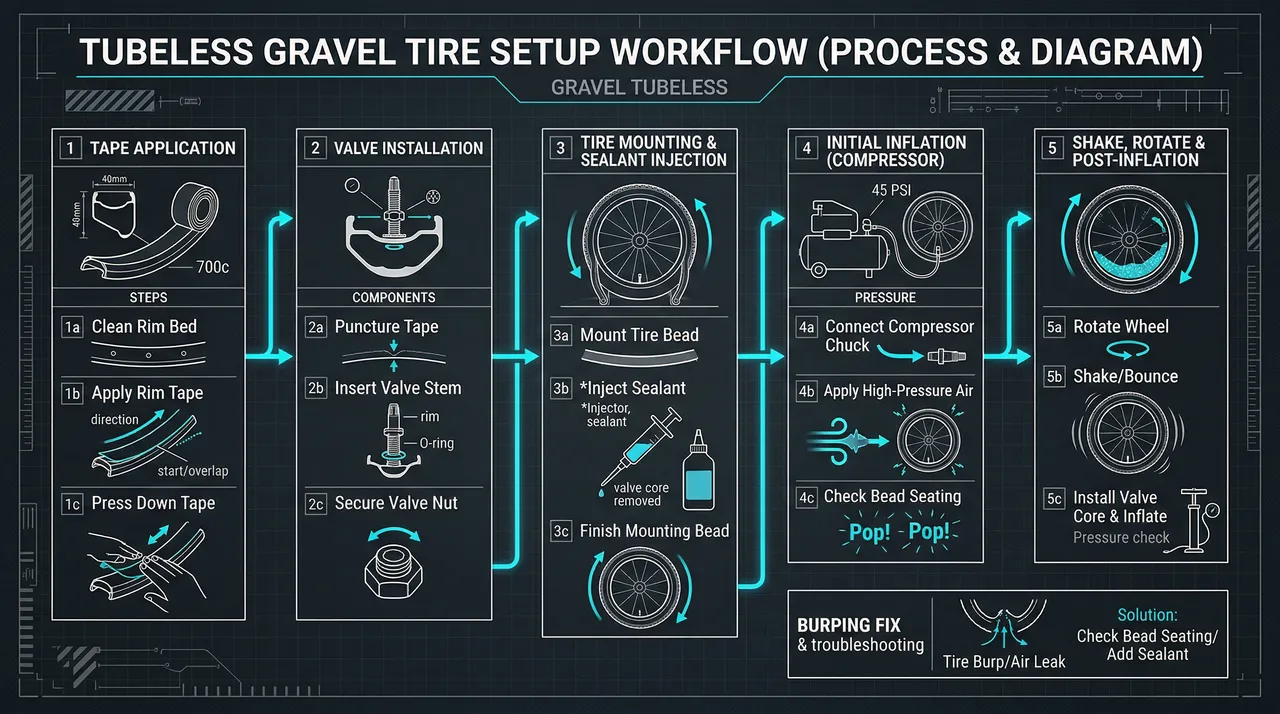
How to Apply Tape (The Right Way)
- Clean the rim: Wipe with isopropyl alcohol. Remove old tape, adhesive residue, and dirt.
- Start opposite the valve hole: Place the tape end on the rim bed, then wrap in the direction of wheel rotation (forward). This keeps overlap from peeling up under pressure.
- Apply tension: Pull the tape tight as you wrap — not enough to stretch it, but enough to eliminate wrinkles.
- Two continuous wraps: Overlap the start by 3‑4 inches, then continue around again. Do not cut and restart; that creates a weak point.
- Poke the valve hole: Use a sharp awl or the valve itself. Do not cut an X — that creates four flaps that can leak.
How to Test Tape
After taping, install the valve (without tire) and inflate to 50 PSI. Submerge the rim in a tub of water or spray with soapy water. If you see bubbles, the tape is leaking. Dry, re‑tape, test again.
Sealant: Quantity and Type
Sealant is not “set and forget.” It evaporates, coagulates, and loses effectiveness over time.
Sealant by Tire Volume (Gravel)
- 40‑45mm tires: 40‑50ml per tire
- 45‑50mm tires: 50‑60ml per tire
- 50‑55mm (2.0‑2.1 inch): 60‑70ml per tire
- 55‑57mm (2.2‑2.25 inch): 70‑80ml per tire
These are initial fill amounts. Top off with 30‑40ml every 2‑3 months.
Sealant Brands Compared
- Stan's NoTubes Race: Fast‑sealing, good for race day. Dries out in 2‑3 months. Mild cleanup.
- Orange Seal Endurance: Slower to seal, but lasts 4‑6 months. Contains fibers that plug larger holes.
- Muc‑Off Bio: Water‑based, easy cleanup, eco‑friendly. Sealing power is moderate; best for non‑aggressive riding.
- Silca Ultimate: Expensive, but includes graphene particles for better sealing of cuts up to 6mm.
Seating the Tire
Gravel tires, especially wide ones, can be stubborn to seat. Here is the method that works 95% of the time:
- Install taped rim, valve, tire (no sealant yet).
- Remove valve core.
- Use a high‑volume pump or compressor to blast air in quickly. You will hear a distinct “pop‑pop” as the beads seat.
- Re‑insert valve core, inflate to 40 PSI.
- Shake and rotate the wheel to spread sealant evenly around the inside of the tire.
- Drop to your riding pressure (25‑35 PSI).
Common Failures and Fixes
1. Slow Leak at the Valve
Symptom: Loses 5‑10 PSI overnight, always from the same wheel.
Fix: Remove valve, clean rim hole, apply a thin layer of tubeless sealant to the valve rubber before re‑tightening. Use a valve nut (snug, not cranked) to hold the valve in place.
2. Bead Won't Seal (Weeps Sealant)
Symptom: Tiny bubbles of sealant weeping from the bead‑to‑rim interface, especially near the valve.
Fix: Inflate to 50 PSI, bounce the wheel on the ground, spin, repeat. If it still weeps, add 10ml more sealant and ride it for 20 minutes — the motion often seals micro‑gaps.
3. Burping on Rocky Terrain
Symptom: Loud “pfft” sound on sharp impacts, pressure drops 5‑10 PSI instantly.
Fix: Add 2‑3 PSI, ensure you have enough sealant (60ml+ for wide tires), consider a tire with a stiffer bead (WTB TCS Tough vs TCS Light). If you are on hookless rims, burping is more common — you may need to stay at higher pressures.
4. Sealant Dried Into Rubber Balls
Symptom: Shaking the tire produces a “maraca” sound of dried sealant balls.
Fix: Remove tire, scrape out dried sealant with a tire lever or dedicated scraper, re‑install with fresh sealant. Prevention: top off every 2‑3 months, even if the tire still holds air.
The Hookless Special Case
Hookless rims are less forgiving of imperfect setups. The bead must seat perfectly around the entire circumference. If it does not, the tire can unseat under cornering loads, not just burp.
Hookless‑specific tips:
- Use a compressor or high‑volume booster — floor pumps often lack the sudden air volume needed.
- Inflate to 50 PSI, bounce, spin, then drop to riding pressure. Do not ride at 30 PSI if the bead seated at 30 PSI; it may not be fully seated.
- Check the manufacturer's compatibility list. Some tires just won't seat on some hookless rims, regardless of technique.
Maintenance Schedule
Gravel Tubeless Maintenance Timeline
- Every ride: Check pressure (gravel tires lose 1‑3 PSI per day naturally).
- Monthly: Shake wheels to redistribute sealant.
- Every 2‑3 months: Top off sealant (30‑40ml per tire).
- Every 6 months: Remove tire, clean out dried sealant, inspect tape and valve.
- Annually: Replace tape (even if it looks fine — adhesive degrades).
Bottom line: Tubeless is worth the hassle for gravel — lower pressures, fewer flats, better grip. But it is not “install and forget.” Tape correctly, use enough sealant, seat the beads properly, and maintain it. Fail at any step and you will be fixing leaks instead of riding.
Want to understand more about bicycle standards and compatibility? Check our Disc Brake Mounting Systems guide for Flat Mount, Post Mount, and IS adapter logic.