Hookless vs Hooked Gravel Wheels: The Safety Guide That Actually Matters
April 21, 2026 · 11 min read
Hookless rims are the biggest change in wheel standards since tubeless. They are lighter, potentially stronger, cheaper to manufacture — and, if you get the pairing wrong, they can send a tire flying off the rim at speed. This is not an exaggeration. ETRTO published the official compatibility list in 2024 to prevent exactly that scenario.
So who are hookless rims for? And who should stick with traditional hooked rims for safety and flexibility? Here is the full breakdown, based on the 2026 gravel wheel market, verified tire compatibility lists, and real-world failure data.
The Basic Difference: Bead Lock vs. Bead Cup
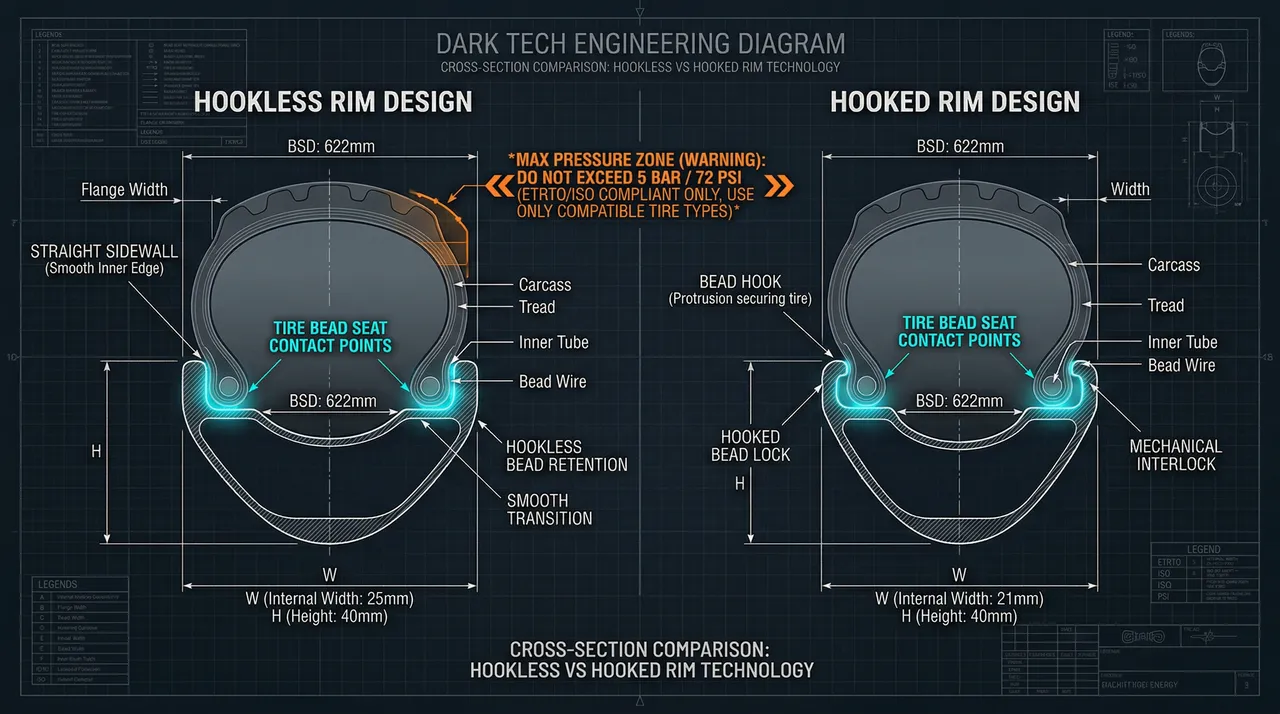
Hooked wheels have a small internal lip called the bead hook. When the tire inflates, the hook catches the tire bead and mechanically locks it in place. This is an extra safety measure that prevents the tire from unseating under side load, which is why hooked rims have been the standard for decades.
Hookless wheels lack that hook. The tire bead sits in a cup-shaped rim channel, held in place by air pressure alone. That reduces weight by about 30–50g per rim and simplifies manufacturing, but it shifts the safety burden onto the tire's bead and the rim's tolerances — which is why hookless compatibility is picky.
ETRTO 2024 Standard: The Limits
Here is what the European Tyre & Rim Technical Organisation (ETRTO) officially says in its 2024-2025 standards:
- Maximum pressure: 72.5 PSI (5 bar) for hookless rims with 25mm internal width.
- Wider rims (30mm+ internal width): 60 PSI max.
- Tire compatibility: Only tires listed in the ETRTO hookless compatibility database are safe. Non-approved tires can be installed, but the bead may not seat correctly, and the risk of sudden unseating under impact increases sharply.
- Manufacturer testing: Rim and tire manufacturers must cross-certify their products in actual lab tests. A tire that is hookless-compatible with Zipp may not be compatible with DT Swiss.
The Pressure Problem
Most gravel riders will never hit the 72.5 PSI hookless ceiling. If you are running 45mm tires at 28–32 PSI, you are fine.
The problem arises with narrow gravel tires on mixed-road rides. A gravel racer might run 35mm tires at 55 PSI for a 60-mile gravel-road race. That is dangerously close to the hookless limit — especially if the rim is a 30mm internal width (60 PSI limit). Add a hot day, a fast descent, and a sharp rock impact, and the tire could unseat.
Known Compatible Gravel Tires (2026)
These brands/models appear on multiple manufacturer compatibility lists:
- WTB: All TCS Light and TCS Tough tires (Riddler, Sendero, Nano, etc.)
- Pirelli: Cinturato Gravel H, Gravel T, Gravel M (all versions)
- Schwalbe: G-One RS, R, S, Allround, Speed; including the new G‑One Pro line
- Continental: Terra Speed, Terra Trail, Terra Hardpack
- Maxxis: Rambler, Receptor
- Specialized: Pathfinder Pro, Sawtooth
The Burping Risk
Even with a compatible tire/rim pair, hookless wheels are more likely to burp (the bead momentarily unseats, releasing air) on square-edge impacts. If you ride rocky, technical gravel at low pressures (18–25 PSI), a sharp impact can flex the rim enough for the bead to lose its seal.
The fix: a few extra milliliters of sealant (60 ml vs 45 ml per tire) and a slightly higher pressure (2–3 PSI) to keep the bead seated.
Who Should Go Hookless?
Hookless makes sense for riders who:
- Run 45mm+ tires at moderate pressures (25–35 PSI)
- Use hookless-approved tires from the compatibility list
- Want the weight reduction (typically 60–80g per wheelset)
- Do not plan to mix and match tires frequently
Who Should Stay Hooked?
Stick with hooked rims if you:
- Run narrow gravel tires (35–40mm) at 45+ PSI
- Travel with the bike and might need to buy whatever replacement tire is available locally
- Frequently swap between tires (road slicks for commuting, knobbies for weekend)
- Ride rocky, high-impact terrain where burping is already a risk
Quick Check: Are Your Wheels Hookless?
If you are not sure:
- Look inside the rim. No internal lip? It is hookless.
- Check the rim manufacturer's website for hookless compatibility lists.
- If the rim is ENVE, Zipp, or DT Swiss Gravel LN (2024+), it is most likely hookless. If it is DT Swiss G1800, Mavic, or older ENVE, it may be hooked.
Bottom line: Hookless is safe when you follow the rules — compatible tires, pressure within limit, proper seating. But it is not a free upgrade; it is a system. If you break any part of the system, you lose safety. Hooked rims give you margin for error, which is why they are not going away.