Gravel Tire Width Guide: 40mm vs 45mm vs 50mm vs 2.25” — Real Numbers
Rolling resistance, grip, weight penalty per mm, and gear inch tables. Four metrics across every major gravel tire width.
Related: 45mm Is the New Minimum Gravel Tire • eBikePSI Tire Pressure Calculator
“What tire width should I run?” is the question every gravel cyclist asks eventually. The honest answer depends on your terrain, your frame clearance, and your priorities — but instead of vague guidance, here are the actual numbers across four key metrics: rolling resistance, weight, grip, and effective gearing.
Rolling Resistance: What the Data Shows
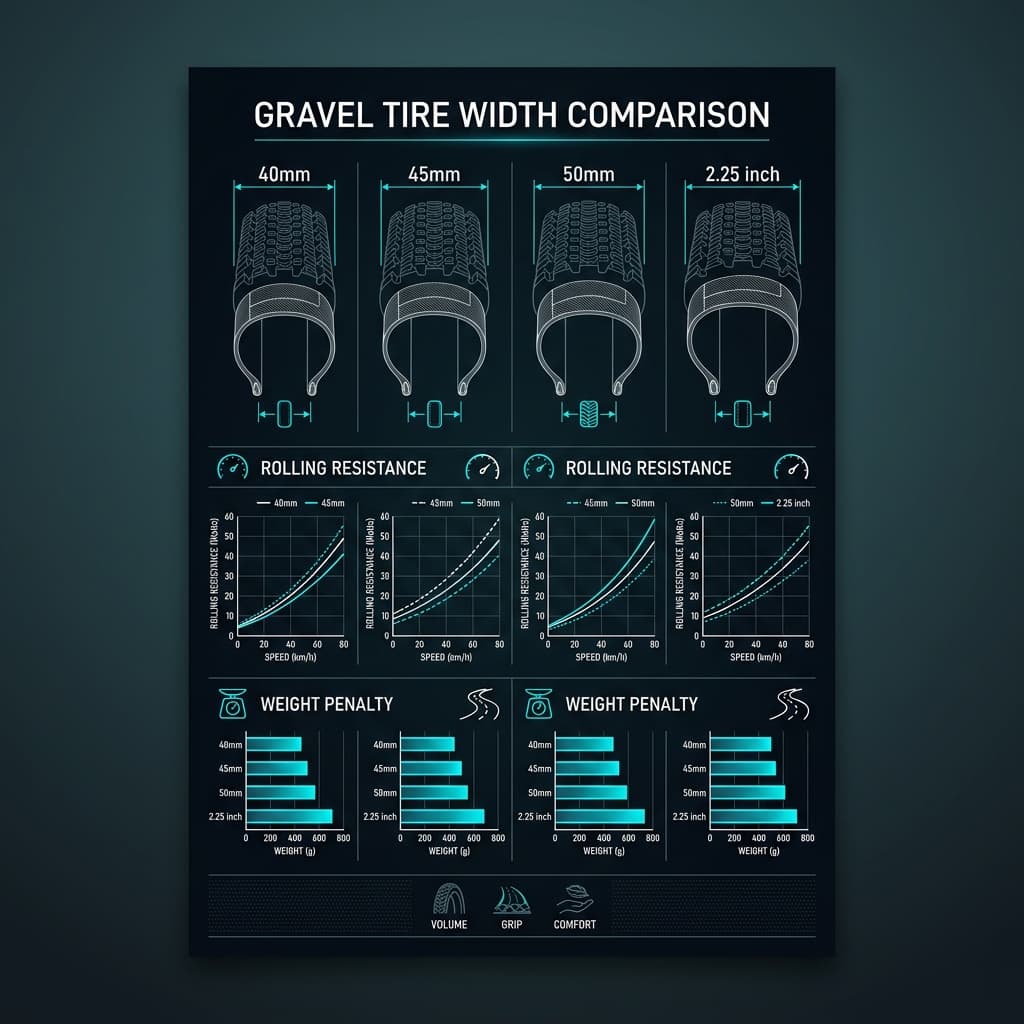
The counterintuitive truth — confirmed repeatedly by independent testing at bicyclerollingresistance.com and internal testing by tire brands — is that wider tires often roll faster on rough surfaces. Why? Two reasons:
- Lower operating pressure: A 45mm tire at 28 PSI has a larger contact patch and deforms around obstacles instead of bouncing off them. That deflection absorbs energy that would otherwise travel into your body (as vibration) and back into the road as noise.
- Reduced suspension losses: Your body is heavy. Every vibration that travels from the road through the tire into you and back costs energy. Wider tires reduce this systemic loss significantly on rough terrain.
Rolling Resistance Summary by Surface
| Width | Smooth Tarmac | Packed Gravel | Rough/Loose |
|---|---|---|---|
| 40mm | Fastest | Mid | Slowest |
| 45mm | Very good | Fastest | Fast |
| 50mm | Good | Very fast | Fastest |
| 2.25" (57mm) | Slowest | Good | Fastest |
Rankings are relative within category and assume appropriate PSI for each width.
Weight Penalty Per Width
Wider tires are heavier — that's unavoidable. But the penalty is often overstated. Here's the actual range for quality gravel tires (tubeless-ready, single compound):
Weight stated per tire. Pair weight = approx. 2×.
Grip: Where Width Actually Matters
Wider tires provide more grip in two ways: larger contact patch and lower operating pressure. Lower PSI means the tread conforms to surface irregularities. This matters most in:
- Loose over hard (sand over hardpack, gravel over clay)
- Wet roots and rocks
- Off-camber sections where side-knob engagement matters
- Deep mud (though tread pattern matters more than width here)
On dry hardpack and compact gravel, grip differences between 40mm and 50mm are negligible. The gains are surface-specific, not universal.
Effective Gearing Changes
Every 5mm of additional tire width adds roughly 1.5-2% to circumference. This makes your effective gearing proportionally taller. Here's how that plays out for a common 34t chainring setup:
34t Chainring — Effective Gear Inches by Tire Width
| Tire Width | Easiest (×46t) | Hardest (×11t) | Change vs 40mm |
|---|---|---|---|
| 40mm | 19.3 gi | 80.8 gi | baseline |
| 45mm | 19.8 gi | 82.8 gi | +2.5% |
| 50mm | 20.3 gi | 84.9 gi | +5.1% |
| 2.25" (57mm) | 21.1 gi | 88.3 gi | +9.2% |
If going from 40mm to 50mm feels like climbing got harder, it has — by about 5%. A 32t chainring restores parity.
For most riders switching from 40mm to 45mm, the gear change is small enough to ignore. Going to 50mm or 2.25" tires warrants reconsidering your chainring size. Use CrankSmith's drivetrain calculator to run your exact numbers. For optimal PSI for each tire width and your rider weight, see the eBikePSI Tire Pressure Calculator.