45mm Is the New Minimum Gravel Tire — Here's Why
Every major 2026 gravel frame clears 50mm+. Riders are pushing past 40mm and never looking back. The data backs it up.
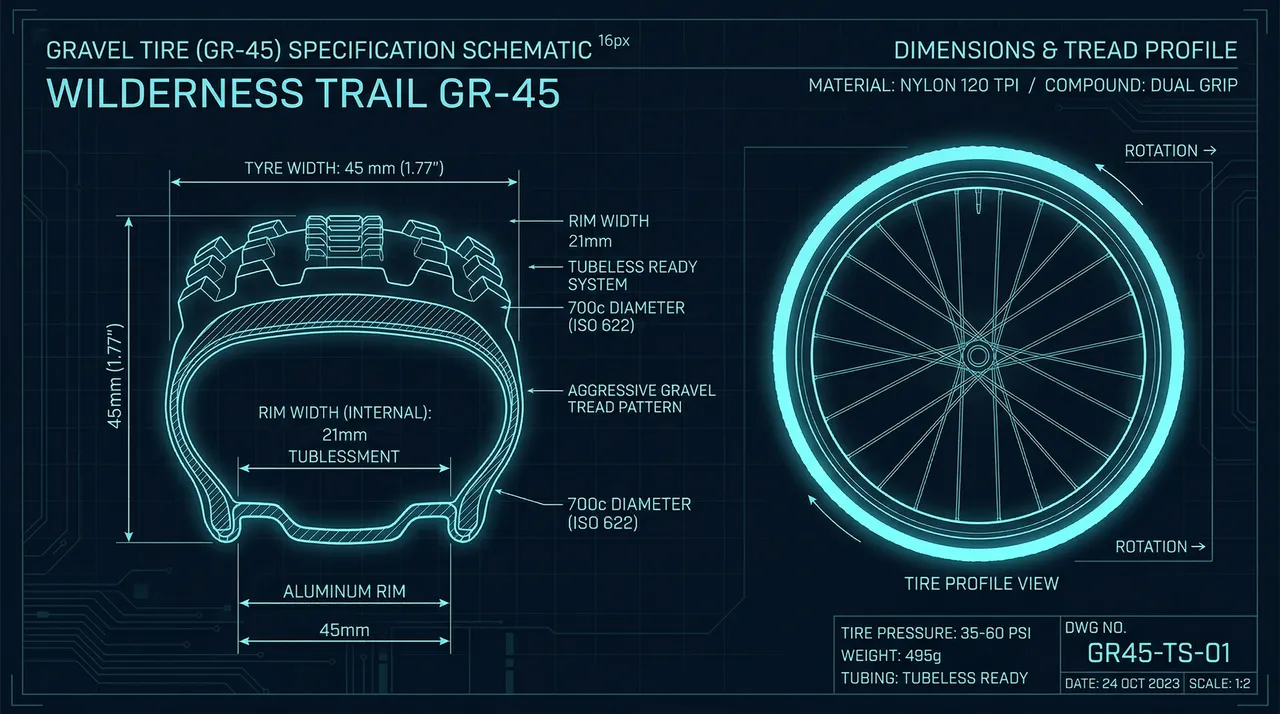
If you're still running 35mm or 40mm tires on your gravel bike, you're riding on last decade's setup. 45mm has become the accepted minimum for general gravel riding, and for good reason. The combination of rolling efficiency, puncture protection, and the ability to run lower pressures for grip makes wider tires objectively faster on most real-world gravel surfaces.
What Changed?
Related reading: BikeRadar: "Don't Buy a Gravel Bike Without 50mm Tyre Clearance" • CyclingWeekly's 2026-27 Gravel Tech Predictions
The 2026 gravel frame market has shifted. Where 40mm clearance was once considered generous, 50mm is now the baseline expectation for new gravel bikes. The Specialized Diverge clears 55mm. The Allied Able handles 57mm. Even mid-range carbon frames are opening up their chainstays and fork crowns to accommodate 50mm+ rubber.
This isn't just manufacturer marketing — it reflects real rider behavior. On Reddit and gravel forums, riders who switch from 35mm or 40mm to 45mm consistently report faster times on rough gravel, fewer flats, and a more comfortable ride without a measurable speed penalty on pavement. The physics: at lower pressures (20-30 PSI range for wider tires), the tire deforms around obstacles instead of bouncing off them, maintaining momentum. For personalized PSI recommendations by weight and tire width, try the eBikePSI Tire Pressure Calculator.
The Rolling Resistance Reality
Independent testing has confirmed what gravel racers already knew: wider tires often roll faster than narrow tires on rough surfaces. A 45mm tire at 30 PSI will outperform a 35mm tire at 50 PSI on anything but perfectly smooth tarmac. The energy lost to suspension (your body vibrating) far exceeds the marginal increase in tire deformation. See BikeRadar's independent tire testing for the full data.
Real-World Tire Width Feedback (2026)
- 35-40mm: “Feels outdated on real gravel.” Fast on pavement, harsh on rough stuff.
- 45mm: The standard. Fast on rough, comfortable, confident in corners.
- 50mm: Preferred by aggressive riders. More grip, more comfort, slightly heavier.
- 55mm+: For 2.1"+ setups. Best on technical terrain, ponderous on pavement.
So What Should You Run?
For most gravel riders in 2026, 45mm is the sweet spot. It's wide enough to excel on real gravel while still feeling planted on hard-pack and pavement. If you're racing or riding technical terrain, 50mm is increasingly the choice. Only drop to 40mm or below if your rides are predominantly pavement with occasional gravel sections.
The real question isn't “how wide can I go” — it's “does my frame actually fit the tire I want?” That's where CrankSmith comes in. Enter your frame model and target tire size, and the builder checks real clearance data including room for mud, which most manufacturers don't publish.
Going Even Wider?
If 45mm isn't enough for your terrain, some 2026 frames officially clear 2.25-inch (57mm) MTB tires. And if you're running wider tires, your effective gearing changes too — wider tires = larger circumference = taller gears. CrankSmith calculates all of this automatically.