Shimano GRX vs SRAM AXS XPLR vs Campagnolo Ekar — 2026
Three groupsets. One table. Weight, range, price, and the questions nobody asks — answered with real specs.
Want full depth on how these systems work? See the CrankSmith Gravel Groupsets Explained Guide. This post is the quick comparison.
Three companies make groupsets designed specifically for gravel. They have different philosophies — wireless vs mechanical, 12 vs 13 speed, Japanese precision vs Italian romance — and very different price points. Here's the honest comparison without the brand loyalty.
The Spec Table
| Spec | GRX 820 | Force XPLR AXS | Ekar 13s |
|---|---|---|---|
| Speed | 12 | 12 | 13 |
| Shifting type | Mechanical (Di2 option) | Wireless electronic | Mechanical |
| Cassette range | 10-45t (Di2: 10-51t) | 10-44t (Eagle: 10-52t) | 9-42t |
| Chainring options | 40t, 42t, 46/30t | 40t, 43t, 46/33t | 38t, 40t |
| Groupset weight* | ~2,700g | ~2,550g (no cables) | ~2,800g |
| Price (complete)** | $600–$1,400 | $900–$2,400 | $850–$1,200 |
| Battery life | N/A (mechanical) | ~60h shifting | N/A (mechanical) |
| Brake type | Hydraulic disc | Hydraulic disc | Hydraulic disc |
| Brake mount | Flat mount | Flat mount | Flat mount |
| UDH compatible | No | Yes (Transmission) | No |
*Approximate. **Complete groupset: derailleurs, shifters, cassette, chain, brakes, crankset.
Key Differences
Shimano GRX 820 — The Reliable Workhorse
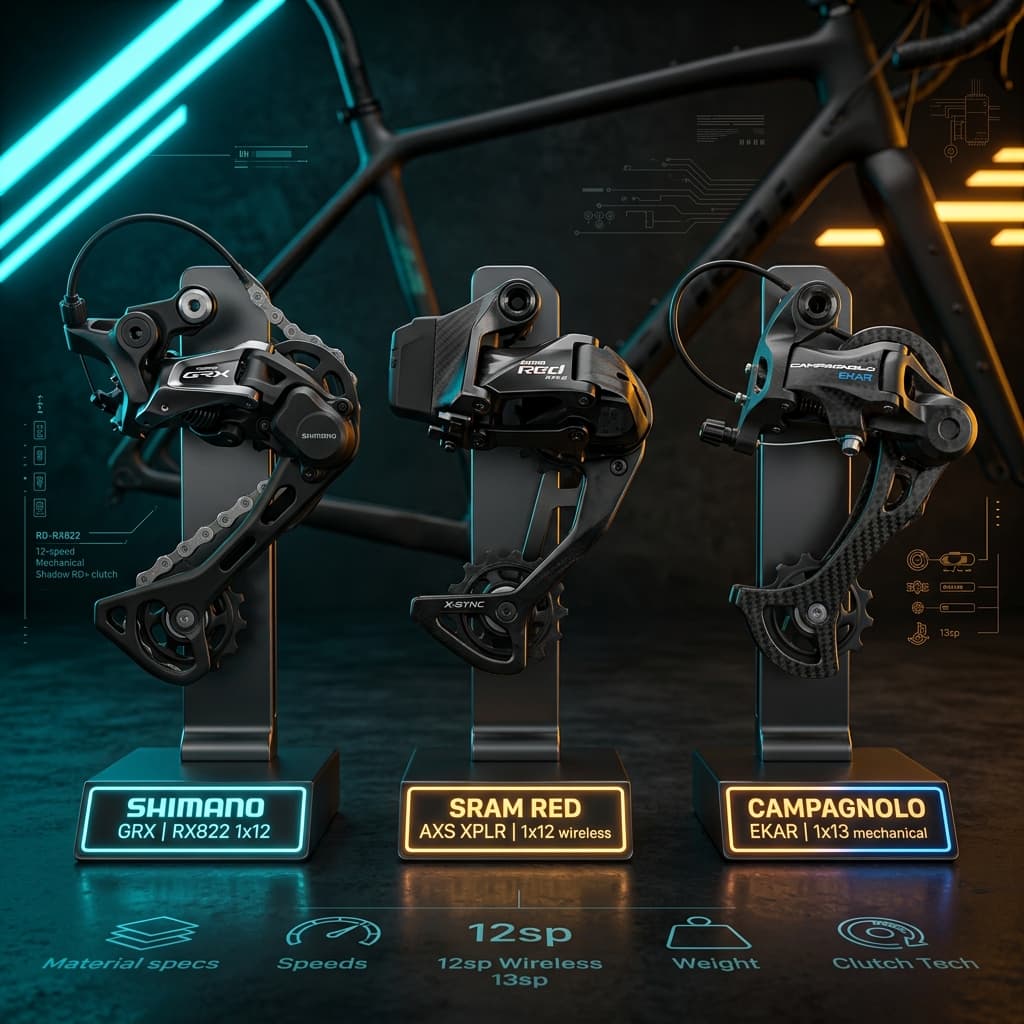
GRX remains the most widely deployed gravel groupset on the market, and for good reason. The ergonomics are excellent, the hydraulic brakes have outstanding modulation, and the mechanical version is repairable anywhere in the world with a cable and barrel adjuster. The 12-speed range covers most terrain. Di2 electronic option adds wireless shifting at a significant cost premium. Best for: All-weather riding, international bikepacking, riders who prioritize brake feel and repairability.
SRAM Force/Rival XPLR AXS — The Tech Stack
SRAM went all-in on wireless. AXS eliminates cables entirely — no cable stretch, no housing routing, just a Bluetooth module and a coin cell battery. The ecosystem is tight: dropper posts, power meters, and shifting all talk to the same app. The XPLR Eagle cassette (optional) extends to 10-52t for massive range. Rival XPLR AXS is the value version, ~$400 cheaper than Force with negligible performance difference. Best for: Tech-forward riders, those who prioritize shifting convenience and ecosystem integration.
Campagnolo Ekar 13-Speed — The Niche Choice
Ekar's 13-speed cassette gives the tightest gear steps of any gravel groupset — important for riders who hate the cadence jumps that come with wide-range 12-speed setups. The 9-42t cassette is relatively compact, which suits fast terrain better than sustained climbing. The mechanics are superb. The catch: if something breaks in the backcountry, you need Campagnolo-specific parts. Best for: Road-oriented gravel riders, those who prioritize gear step feel over maximum range.
Budget Options That Don't Suck
If the prices above made you wince, these alternatives deliver real gravel performance at much lower cost:
- SRAM Apex XPLR AXS (~$650-800) — Entry wireless 1x. Same AXS protocol, slightly heavier components. The best bang-for-buck electronic gravel groupset in 2026.
- Shimano GRX 610 (~$500-650) — 11-speed, mechanical, proven reliability. Not as wide-ranging as 12-speed but completely capable for most riding.
- Shimano CUES U6000 (~$350-450) — LinkGlide technology extends chain life 3× over standard 12-speed. Ideal for high-mileage commuter-gravel riders.
- MicroShift Advent X (~$250-350) — 10-speed with 11-48t cassette and real clutch derailleur. Genuinely good performance at an absurdly low price point.
For a deeper look at how these drivetrain systems work under the hood — gear ratios, compatibility matrices, electronic protocol differences — see the full Gravel Groupsets Explained guide.