How Tire Width Changes Your Gravel Gearing -- The Math No One Talks About
April 14, 2026 -- 9 min read
Switching from 35mm to 50mm tires is the exact same effective gear change as swapping from a 40t to a 43t chainring.
No new cranks. No new cassette. Just different tires. And suddenly your bike feels geared too tall for the climbs you used to handle fine.
Let us break down the math, because it matters every time you put bigger rubber on a gravel bike.
The Math Behind Effective Gear Inches
Gear inches tell you how far your bike moves forward with one full pedal revolution:
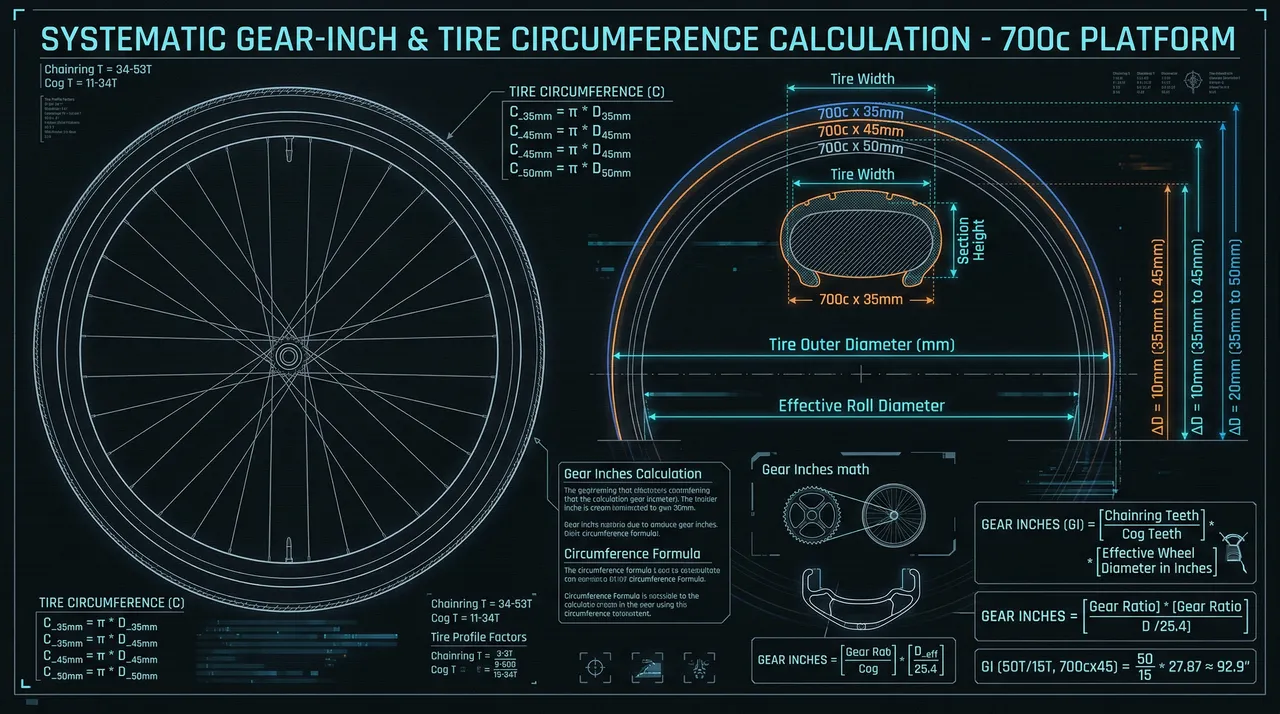
Effective Gear Inches = (Chainring divided by Cog) times (Tire Diameter in Inches)
The tire diameter includes the rim plus the tire height on both sides. For a 700c rim (622mm bead seat diameter):
- 700x35c tire: 622 + (35 times 2) = 692mm approximately 27.2 inches diameter
- 700x45c tire: 622 + (45 times 2) = 712mm approximately 28.0 inches diameter
- 700x50c tire: 622 + (50 times 2) = 722mm approximately 28.4 inches diameter
- 27.5x2.0 inch MTB tire: approximately 29.1 inches diameter
That means a 45mm tire has a 2.9% larger diameter than a 35mm tire. And because gear inches are proportional to diameter, it makes your entire gear range 2.9% taller. Every gear.
The Real-World Impact: 40t with 45mm vs 35mm
Let us use the most common modern gravel setup: 40t chainring, 10-44t cassette.
Lowest gear (40t divided by 44t):
- With 35mm tires: 24.7 gear inches (easy climbing)
- With 45mm tires: 25.5 gear inches (noticeably harder)
- With 50mm tires: 25.8 gear inches (that is a 42t chainring feeling)
That 25.5 gear inches with 45mm tires? That is equivalent to running a 41.2t chainring -- and chainrings only come in whole numbers. You have essentially upped your chainring by 1.2 teeth just by changing tires.
For a 150-lb rider on 8% grades, the difference between 24.7 and 25.8 gear inches is about 2.2 additional watts per pedal stroke. That does not sound like much until you are 40 minutes into a steep gravel climb on a hot day and you are standing up when your buddy on narrower tires is still spinning.
When Does This Actually Matter?
1. You Are Building Around Wide Tires
If you are buying a new frame that clears 50mm+ and you plan to run big tires year-round, size your chainring accordingly. A 38t or even 36t chainring with a 10-52t cassette makes more sense than the standard 40t.
2. You Switch Between a Road and Gravel Quiver
If you have one bike with 35mm slicks for fast road days and the same bike with 50mm knobbies for weekend trail rides, your gearing is going to feel like two different bikes. This is one reason some riders prefer 2x -- it gives you enough range to cover both setups.
3. You Are Running an Unbound Build (50mm+ in Kansas)
Riders using 50mm+ tires for Unbound Gravel should consider a smaller chainring (36-38t) paired with a 10-52t cassette. We break down full Unbound setups in our dedicated guide.
Compensating: What Should You Change?
Option A: Smaller Chainring (Easiest, Cheapest)
Drop your chainring by 2-4 teeth. A 40t to 38t swap costs about $40 and takes 20 minutes. This perfectly compensates for the gear increase from 35mm to 50mm tires.
Option B: Bigger Cassette
Upgrade to a 10-44t (SRAM XDR) or 10-52t. If you are running a 2x crankset, front derailleur clearance may limit cassette size -- another reason mullet drivetrains are so popular.
For a comprehensive breakdown of all modern gravel groupset options including the full 1x vs 2x landscape, see our Gravel Drivetrain & Groupset Configurations guide.
Option C: Accept It (The Fast Approach)
Many Unbound racers run big gearing because they prioritize top speed on the rolling Flint Hills. If you are strong and your courses are more rolling than mountainous, you might be fine.
Key Takeaways
- Every 5mm of tire width adds roughly 1-1.5% to your effective gear ratio
- A 35mm to 50mm tire swap feels like a 2-3 tooth bigger chainring
- Compensate with a smaller chainring (not a bigger cassette -- it is cheaper)
- For 2.1-inch+ tires, a 34-36t chainring with 10-52t cassette is the smart setup for climbing terrain
Pro tip: If your bike came stock with a 40t chainring and 40mm tires, and you want to run 50mm+ for bikepacking, drop to a 38t chainring. It is a $40 fix that makes your climbing feel like it did before the tire upgrade.