Every 2026 Gravel Frame That Fits 2.25-Inch Tires (57mm)
April 17, 2026 · 9 min read
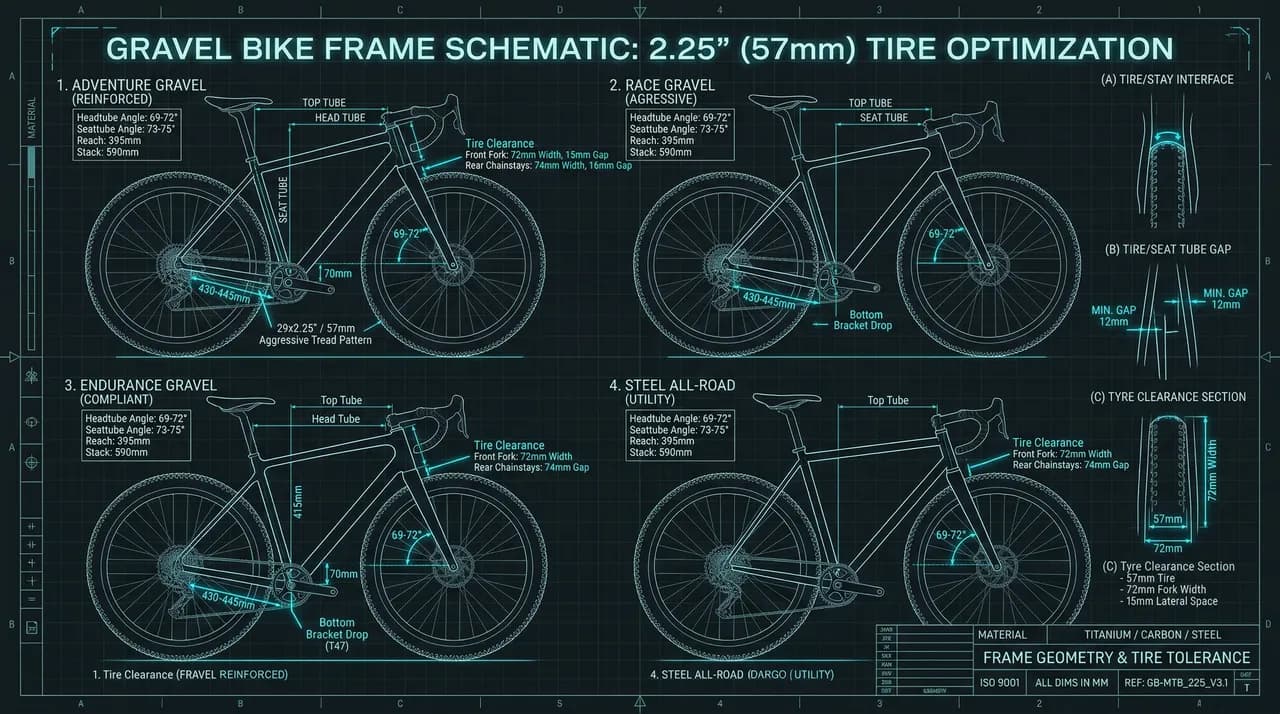
Five years ago, 45mm was the max tire clearance for "adventure" gravel frames. Today, a growing number of gravel frames officially spec 57mm — that is 2.25 inches, solid mountain bike territory — on 650b wheels with drop bars. This is not a fringe mod. This is production geometry.
Here is every frame we could confirm for 2026, organized by how much clearance they actually offer.
The Definitive 2026 List
| Frame | Official Max | Wheel Size | Measured Min Clearance* |
|---|---|---|---|
| Lauf Seigla | 2.4" (61mm) | 650b | ~8mm |
| Open U.P. | 2.2" (56mm) | 650b | ~6mm |
| 3T Exploro Pro | 2.2" (56mm) | 650b | ~6mm |
| Salsa Cutthroat | 2.2" (56mm) | 650b | ~6mm |
| Niner RLT 9 RDO | 700c x 45mm / 650b x 2.0" | 650b | ~5mm on 2.0" |
| Specialized Diverge STR | 700c x 47mm / 650b x 2.1" | 650b | ~5mm on 2.1" |
* Measured clearance at the tightest point (usually chainstays or fork crown) with the tire inflated. Minimum recommended clearance is 6mm to account for mud buildup.
Why 650b, Not 700c?
A 650b wheel with a 57mm tire has roughly the same outer diameter as a 700c wheel with a 37mm tire. That means your bike's geometry — bottom bracket height, trail, stack — all stay in the intended range. Run a 57mm tire on a 700c wheel and your bottom bracket rises nearly 20mm, the bike handles completely differently, and toe overlap becomes a real risk.
Concerned about bottom bracket clearance with 2.25" tires? Our Bottom Bracket Standards guide covers BSA, PF30, and T47 — including how spindle diameter affects chainring clearance and ground clearance.
If you are building around 2.25-inch tires, buy a 650b wheelset. Period.
Frame-by-Frame Notes
Lauf Seigla — The King of Big Tires
The Seigla is the only frame on this list that officially spec's 2.4-inch tires (61mm). That is bigger than almost any gravel bike. The carbon leaf spring fork provides 30mm of compliance without a suspension fork's weight or complexity. It is an unusual design, but it pairs perfectly with massive tires on chunky terrain.
If you want the most tire volume with zero suspension maintenance: this is the frame.
Open U.P. / Open U.P.P.E.R. — The Original Big-Tire Gravel Frame
Gerald Vroomen designed the Open U.P. with the explicit goal of fitting big tires. The asymmetric chainstays open up massive clearance, and the frame has been refined over multiple generations. 2.2 inches (56mm) officially supported, 2.3 inches often possible depending on tire brand.
3T Exploro Pro — Italian Engineering, Real Clearance
3T claims 61mm clearance for the Exploro Pro, but measured clearance with a 57mm tire is closer to 6mm at the tightest point. That is enough for clean riding but leaves no margin for mud. If you are running 2.2-inch tires in muddy conditions, the Exploro Pro will rub. For dry, rocky terrain it is perfect.
Salsa Cutthroat — The Bikepacking Choice
The Cutthroat was designed for the Tour Divide and other ultra-endurance events. 2.2-inch clearance on 650b gives you volume and grip for long days on mixed surfaces, plus massive cargo capacity with triple-cage mounts everywhere. If you are bikepacking more than you are racing: this frame.
Niner RLT 9 RDO — The Safe Pick
Niner officially spec's 700c x 45mm or 650b x 2.0 inches. That is slightly less than 2.25, but still huge by most gravel frame standards. If you want a proven, available frame from a brand with a massive dealer network: the RLT 9 RDO is a safe bet. Drop to 2.0-inch Maxxis Ikon or Rekon and you have a capable gravel-plus ride.
Specialized Diverge STR — The FutureShock Factor
The Diverge STR adds FutureShock 2.0 (suspension in the headset) to the mix, and officially accepts 650b x 2.1-inch tires. That's 53mm — slightly under the 2.25-inch threshold, but still in the big-tire category. The FutureShock fork gives you an additional 20mm of front-end compliance, which is a different approach to the same goal the Lauf Seigla achieves with a leaf spring fork.
What You Lose (Trade-Offs)
Running 2.25-inch tires is not an upgrade without trade-offs:
- Weight: A 57mm tire weighs 550-700g each. Two tires plus 650b wheels adds 300-500g versus a 700c x 40mm setup. That is rotational weight — the most performance-reducing kind.
- Rolling resistance: On pavement, 2.25-inch tires are significantly slower than 40-45mm gravel tires. The speed penalty is real on long paved sections.
- Gearing: A 57mm tire adds ~6% effective diameter versus 50mm. If you are on a 40t chainring, it feels like 42.4t. Check your gear inches with our gearing guide.
- Tire pressure: You are running 15-22 PSI. That is MTB territory. Your tubeless setup and sealant strategy matters a lot more. See our tire pressure by width guide for exact PSI data.
Should You Go This Big?
Here is my honest take: 2.25-inch gravel tires are amazing for specific riding. If you ride technical singletrack, bikepack through the desert, or live in a place where gravel roads feel more like MTB trails — go big. The grip and comfort are transformational.
If you ride fast group rides on mixed pavement and gravel, 45-50mm is the sweet spot. You get most of the comfort benefit without the weight penalty and rolling-resistance hit of 57mm.
Build your ideal setup with CrankSmith — enter your frame, tires, and drivetrain, and we will flag any clearance issues or gearing problems before you buy anything. No surprises, no returns, no "oh that won't fit" moments.
Bottom line: The Lauf Seigla and Open U.P. lead the pack for maximum tire clearance. The Salsa Cutthroat is the bikepacking choice. The Diverge STR brings FutureShock compliance to the mix. Pick the frame that matches your riding, dial the pressure right, and enjoy the most capable gravel bike you can build.