The Gravel Mullet: Road Shifter + MTB Derailleur — Every Combo That Actually Works
SRAM AXS makes it native. Shimano needs a converter. Here is the full compatibility matrix so you can build yours without guesswork.
Related reading: SRAM AXS Compatibility Documentation • Wolf Tooth RoadLink & Tanpan
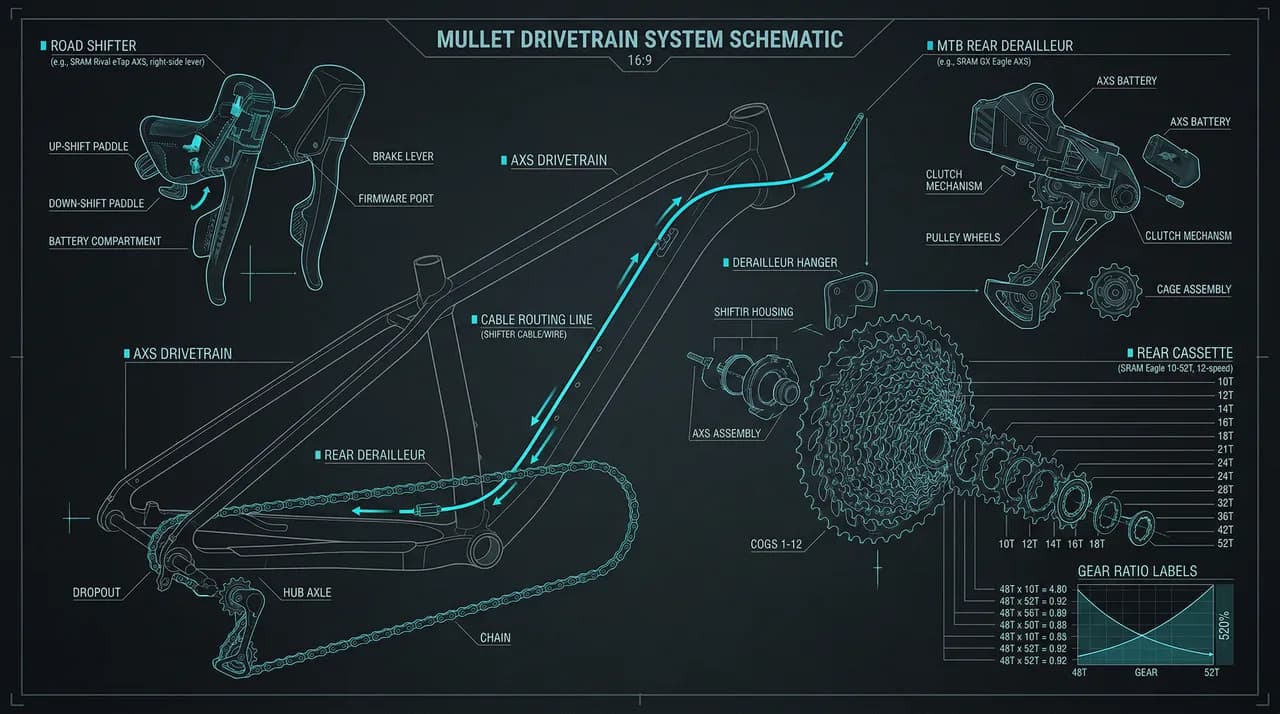
A “mullet” drivetrain is the most popular gravel build trend of the last three years: road or gravel shifters up front, mountain bike derailleur and cassette out back. The result? Drop-bar ergonomics with MTB gearing range — up to 10-52t (520%). If you've ever ground to a halt on a steep gravel climb wishing for one more gear, this is your answer.
SRAM AXS: The Native Mullet
SRAM's wireless AXS ecosystem was designed around universal cross-compatibility. Any AXS Road shifter (Force, Rival, Red, or XPLR) pairs directly with any AXS Mountain derailleur (Eagle XX1, X01, GX). No adapters, no converters, no cable pull math. Just pair in the app and ride.
AXS Mullet — What You Need
- Shifter: Any AXS Road (Force, Rival, Red, XPLR)
- Derailleur: Any AXS MTB Eagle (XX1, X01, GX)
- Cassette: 10-52t Eagle (or 10-50t, 11-50t)
- Chain: 12-speed Eagle chain only (NOT Flattop road chain — it won't engage Eagle pulleys/cassettes)
- Crankset: 1x Road or MTB — does not matter to the system
Shimano GRX: The Cable Pull Problem
Shimano is stricter. Mechanical road shifters pull a different cable ratio than MTB derailleurs, so you can't just wire them together. For mechanical builds, you need a Wolf Tooth Tanpan (cable pull converter) to translate the GRX lever's pull into MTB derailleur travel. Alternatively, the Wolf Tooth RoadLink extends derailleur hanger reach for larger cassettes — but this won't solve cable pull mismatch.
For Di2 electronic, it's more promising but less plug-and-play. You can mix XT Di2 rear derailleurs with GRX Di2 shifters if you resolve the E-Tube project compatibility checks, which often requires a specific display unit or SC-MT800 junction box. Not elegant, but it works once configured.
Real-World Mullet Setups From the 2026 Scene
Mid South 2026 Pro Setups
- 34x11-42 — fast on red dirt, adequate for climbs
- 42x10-46 — the balanced choice
- 42x9-45 — aggressive, for strong riders
- 42x10-52 — climbing-focused, heavy cassette
- 46x10-46 — big-ring rocket for fast sections
Does Your Build Actually Work Together?
The mullet trend has tripped up more builders than any other gravel modification in the past year. SRAM makes it easy, but Shimano requires careful part selection. And even with SRAM, you need to verify that your chosen shifter firmware version supports the MTB derailleur, that your chainline works with your crankset, and that your derailleur hanger is compatible with modern wide-range cassettes.
CrankSmith checks all of this automatically. Select your frame, shifter, derailleur, cassette, and crank, and the builder will flag any incompatibilities before you spend hundreds on parts that don't work together.
Running wider tires with your mullet setup? Your effective gearing shifts taller with every extra mm of tire width. And for loose-surface PSI at events like Mid South or Unbound, the eBikePSI calculator gives personalized recommendations.
For the full technical deep-dive on all modern gravel drivetrain standards, check our Gravel Drivetrain & Groupset Configurations guide covering BSA vs PF30, T47, and bearing choices.