Gravel Tire Pressure by Width: The Definitive Guide (40mm to 2.25 inch)
April 16, 2026 · 10 min read
Run the wrong PSI in your gravel tires and no component upgrade will save you. Run the right PSI and a budget setup beats an overpriced one every time. Tire pressure is the single most impactful adjustment on any gravel bike — and most riders are running it 5-10 PSI wrong.
Here is why that happens: every pressure guide online stops at 45mm. Nobody is talking about 50mm, 55mm, or 2.25-inch tires. But if you are running those widths — and an increasing number of gravel riders are — those 45mm charts actively mislead you.
The PSI Table (All Widths, All Rider Weights)
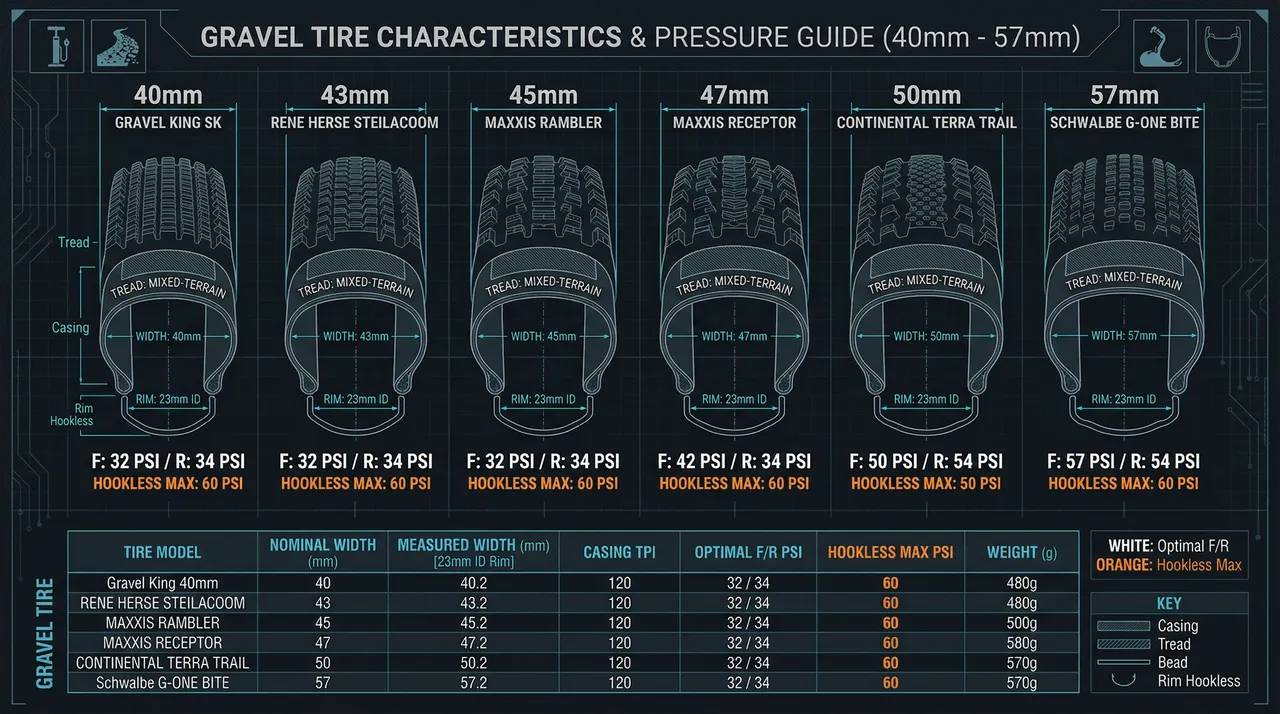
Here is the data you actually need, based on mixed terrain (loose-to-hard-pack gravel, some pavement, a few technical climbs):
| Tire Width | 140 lbs | 160 lbs | 180 lbs | 200 lbs | 220 lbs |
|---|---|---|---|---|---|
| 40mm | 26 F / 28 R | 28 F / 30 R | 30 F / 32 R | 32 F / 34 R | 34 F / 36 R |
| 45mm | 22 F / 24 R | 24 F / 26 R | 26 F / 28 R | 28 F / 30 R | 30 F / 32 R |
| 50mm | 18 F / 20 R | 20 F / 22 R | 22 F / 24 R | 24 F / 26 R | 26 F / 28 R |
| 55mm (2.0") | 15 F / 17 R | 17 F / 19 R | 19 F / 21 R | 21 F / 23 R | 23 F / 25 R |
| 57mm (2.25") | 14 F / 16 R | 16 F / 18 R | 18 F / 20 R | 20 F / 22 R | 22 F / 24 R |
F = Front, R = Rear. Values for standard hooked rims. Hookless: see max PSI section below.
How to Read This Table
This is your starting point. If you are a 170-lb rider on 45mm tires: interpolate between 160 and 180, so roughly 25 F / 27 R. If you are a 210-lb rider on 50mm tires: interpolate to about 25 F / 27 R.
The F/R split exists because your rear tire carries roughly 60% of total weight (rider + bike), so it needs higher pressure to maintain the same casing deflection as the front. Run the same PSI on both and your rear will blow through the casing faster and be more prone to pinch flats.
For a quick starting point, the eBikePSI tire pressure calculator is built on the same rider-weight-plus-tire-width formula. Even though it is designed for e-bikes, the core physics is the same — just enter your combined rider weight and tire size.
The Hookless Pressure Ceiling
If you are running hookless rims (and most new gravel wheels are), you cannot run arbitrary pressure. ETRTO 2024 standards set the absolute maximum at:
- 72.5 PSI (5 bar) for 25mm internal width hookless rims
- Below 60 PSI for 30mm+ internal width hookless rims
In practice, most riders on 45mm+ tires will never hit these ceilings. The danger zone is with narrow gravel tires (35-40mm) on aggressive hookless rims where riders try to run road-level pressures. At those widths, stick to hooked rims if you want 55+ PSI.
For the full breakdown of hookless vs hooked safety, rim brands, and which tires are hookless-approved, read our hookless vs hooked safety guide.
Terrain Adjustments
Once you have your baseline PSI from the table, adjust based on conditions:
- Smooth hard-pack / pavement: Add 2-3 PSI (faster rolling, more responsive).
- Loose gravel / washboard: Subtract 2-3 PSI (more grip, more compliance).
- Mud / wet: Subtract 2 PSI (better traction in corners, more contact patch).
- Rocky technical trails: Subtract 1-2 PSI but watch minimum pressures to avoid pinch flats on sharp impacts.
The 2.25 inch Gravel Tire — Yes, Really
As shown in the table, 57mm (2.25 inch) tires at 160 lbs rider weight run ~16 F / 18 R. That is mountain bike territory. And it works brilliantly for gravel riders who want absurd levels of grip and comfort on technical trails.
The catch: you need a frame that clears 57mm tires. Not all gravel frames do. Check our complete list of 2026 gravel frames that officially fit 2.25 inch tires.
Also note: going from 45mm to 57mm changes your effective gear ratio by about 6% — that is equivalent to going from a 40t to a 42t chainring. Read our tire width gearing guide to see exactly how it affects your setup.
How to Dial It In
- Squirt your tires to the table baseline
- Ride your typical routes and note: do you feel the bike squirming? Go up 2 PSI. Does it feel harsh or bouncy? Drop 2 PSI.
- Refine over 3-4 rides. Your sweet spot will be within +/- 2 PSI of the table.
Bottom line: The table above gets you within 3 PSI of optimal. Ride it in from there. And if your tires feel wrong, pressure is the first thing to check — before new tires, before new wheels, before any component change.